

Engineering Transfer Agreements
MCC students have successfully transferred to universities all across Texas—including Texas A&M, UT Austin, UT Arlington, and Texas Tech, just to name a few.
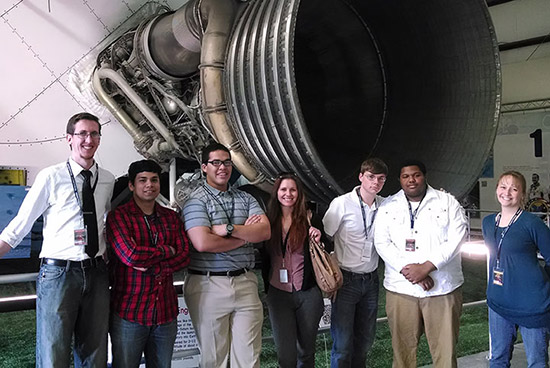
Transferring can be a complicated process, so it pays to be prepared. Most students who transfer successfully have completed Calculus I–III, calculus-based Physics I–II, Chemistry, and their core engineering coursework. Every situation is a little different, and our faculty is here to help you figure out the best path for you.
Use the sections below to explore your transfer options and the matching degree plans at MCC. Options are listed both by school and by major.
Transfer Agreements by School

McLennan Community College
Associate of Science in Engineering
Biomedical
Chemical
Civil
Electrical
Industrial
Mechanical

Texas Tech University
Associate of Science in Engineering
Chemical
Civil
Computer
Computer Science
Construction
Electrical
Environmental
Industrial
Mechanical
Petroleum


Texas State University
Civil
Electrical
Industrial
Manufacturing
College of Science and Engineering Advising Center

Transfer Agreements by Degree
Civil Engineering
MCC (AS Only)
Angelo State
Southern Methodist (SMU)
Texas Tech
Tarleton State
UT Arlington
Electrical Engineering
MCC (AS Only)
Southern Methodist (SMU)
Texas Tech
Tarleton State
Baylor
UT Arlington
Guaranteed Transfer

Texas state law protects students who complete a Field of Study (FOS) curriculum. Here's what that means for you:
If you are studying Mechanical, Electrical, Chemical, or Civil Engineering at a Texas community college, and you complete the courses listed in your Field of Study with a C or better, those courses must be applied to your engineering degree when you transfer to any Texas public university—not as electives, but as actual graduation requirements. This is the law.
If a university does not accept your FOS courses—or if you think you were denied admission because of them—you have the right to file a complaint at https://www1.thecb.state.tx.us/Apps/CRAFT/Home/Create. Every complaint is reviewed and taken seriously.
If you transfer with a complete FOS, the university cannot require you to retake lower-division courses in your major. Here are a few examples of how this works:
- Institution A requires Intro to Civil Engineering for Civil Engineering majors. If you have the full Civil Engineering FOS, you do not have to take it.
- Institution B requires Intro to Engineering for all engineering majors. You do have to take it.
- Institution C requires Intro to College for all majors. You do have to take it.
The rule is simple: if it's a requirement specific to your major, your FOS covers it. If it applies to everyone, it still applies to you.